As an Amazon Associate, we earn from qualifying purchases. This post contains affiliate links, and buying through one costs you nothing extra.
LEAVE

- Portafilter, scoop/tamper and two filters included
- Stainless steel boiler built to last for years
- Manual steam wand for textured milk

- Three presets: espresso, double espresso, cold brew
- Professional pump with 9-bar extraction
- Soft-touch digital display with full-color icons
- Advanced Thermoblock for fast, stable heating
- Conical burr grinder with 8 grind settings
- Commercial-style steam wand for micro-foam
- Cold brew in under 5 minutes

- Semi-automatic: grinds, doses, brews and froths
- 10 preset recipes, all customizable
- Bean Adapt guides grind, dose and temperature
- Real-time feedback on adjustments

- Built-in grinder with 15 settings
- Lever-operated smart tamping for even tamp
- 19-bar Italian pump, 9 bars during extraction
- Seven one-touch bean-to-cup recipes
- Automatic milk frother, removable and dishwasher-safe
- Integrated conical burr grinder with 13 settings

- 20 preset hot and iced recipes
- Three brewing technologies: espresso, drip, cold brew
- Hot and cold milk frothing, dishwasher-safe

- Grind, dose, brew and froth in one touch
- 18 preset recipes including latte and cortado
- Two removable 8.8-oz bean hoppers, regular or decaf
- Adjustable intensity, quantity and extra shot

- 50+ one-touch hot and cold recipes
- Automatic frother for hot or cold foam
- 13-setting built-in burr grinder

- Bean Adapt sets grind settings automatically
- Integrated burr grinder for consistent quality
- 38 recipes across espresso, drip and cold brew
Introduction
De'Longhi makes a lot of espresso machines, and they look alike at first glance. Some are manual, some are fully automatic, and some sit somewhere in between. Choosing one can feel like guesswork, mostly because the differences that matter are hidden in the details: who does the grinding, who does the tamping, and who decides when the milk is ready.
The type of machine you choose decides how much of the work stays with you. A manual machine asks you to dose, tamp and time each shot yourself, and it rewards that effort with control over the result. A semi-automatic machine grinds and brews for you, but you still judge the grind, the dose and the milk texture. A fully automatic machine handles nearly everything with a single tap, trading some hands-on control for speed and consistency. Finding where a model sits on that scale is a quick way to narrow your options.
Milk is the other big divide. Some models ask you to steam by hand with a wand, which takes practice but lets you shape microfoam for latte art. Others froth automatically, so you press a button and walk away. If you drink mostly milk-based drinks, this difference will affect your daily experience more than almost any other spec.
Every description here comes from the product listings themselves, so the comparison reflects what each maker claims, not independent testing. Where a listing promises a feature, we'll note it as the listing's claim. This guide compares ten De'Longhi machines based on their listed specs. For each one, we cover what it includes, how it makes milk, and who it suits. By the end, you should know which type fits your morning routine.
Product Reviews
The section is headed "Product Reviews," and the article's ten machines are all De'Longhi models, so a reader comparing them needs a way to read the list. The models divide into three groups by how much of the work the machine does for you. Manual machines, such as the Compact Manual, leave grinding, dosing, tamping and milk texturing to you. Semi-automatic machines, such as the La Specialista line, grind and brew but expect you to handle some steps yourself. Fully automatic machines, such as the Magnifica, Rivelia, Eletta and PrimaDonna, handle the whole cycle at the press of a button.
Choose by how much hands-on work you want. If you enjoy dialing in a shot and steaming milk for latte art, a manual or semi-automatic model suits you. If you want consistent drinks with little effort, a fully automatic model fits better. The specifications in each listing show which features each machine includes, so compare those against the way you actually make coffee at home.
1. De'Longhi Stilosa Compact Manual Espresso Machine
This is the simplest machine on the list. It's built for someone who wants to learn the craft and doesn't mind doing the work. The listing includes a portafilter, a measuring scoop with tamper, and two filters for single or double shots. A manual steam wand lets you texture milk for lattes and cappuccinos.
Pros
- Includes the basic barista tools you need to start
- Manual steam wand gives you control over milk texture
- The listing describes a stainless steel boiler built to last
Cons
- You grind, dose, and tamp by hand, so it takes practice
- No built-in grinder, so you'll need to buy beans already ground or add your own grinder
2. De'Longhi Dedica Duo Compact Espresso Machine
This is a compact machine with a lot of modern features. It has three presets for espresso, double espresso, and cold brew, plus a digital touch display with color icons. The listing mentions a pump delivering 9-bar pressure and a stainless steel finish with a compact design.
Pros
- Presets make it easy to switch between hot and iced drinks
- The My LatteArt steam wand can make microfoam for latte art
- Compact footprint suits small counters
Cons
- No built-in grinder listed, so you'll need freshly ground coffee
- Fewer presets than the larger automatic models
3. De'Longhi La Specialista Arte Evo Espresso Machine with Coffee Grinder
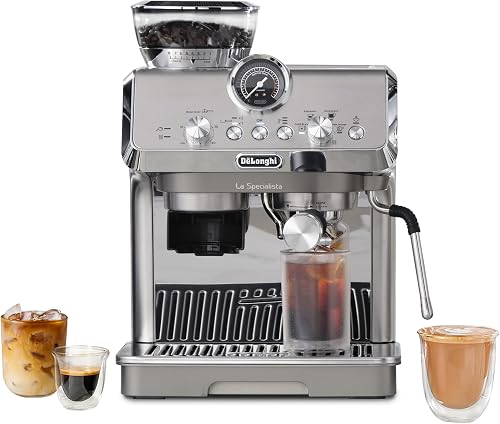
This machine puts a built-in conical burr grinder, a manual steam wand, and a barista kit in one unit. The grinder offers eight grind settings, which lets you work through different bean varieties and find the setting that suits each one. The listing describes a built-in grinder with eight settings for dialing in different beans. Freshly ground coffee gives a consistent dose for a single or double espresso, and the same grinder can prepare beans for cold brew.
Active Temperature Control offers three infusion temperatures, so the water temperature stays stable through the brew. The listing notes that beans with different roasting levels need their own temperature setting for the best extraction. If you usually buy one roast and rarely change it, you may only ever use one of these temperature settings.
The steam wand is commercial-style and heats up quickly, and it delivers the steam pressure needed for smooth micro-foam. The barista kit includes a dosing and tamping guide and a tamping mat, which help you apply even pressure on each grind.
The listing gives four presets: espresso, Americano, cold brew, and hot water. You can adjust these to suit your taste. Milk frothing is manual through the steam wand.
4. De'Longhi La Specialista Touch Espresso Machine with Coffee Grinder
This is the guided model in the La Specialista line. Bean Adapt walks you through grind, dose, pre-infusion, and temperature with a visual guide. It offers 10 preset recipes, including cappuccino, latte, and flat white, and a grinder with 15 settings.
Pros
- Bean Adapt guidance helps beginners dial in their shots
- 15 grind settings give fine control
- Automatic milk frothing with five froth levels plus a manual option
Cons
- More buttons and settings can feel busy for someone who wants simple coffee
- Guided features take time to learn
5. De'Longhi La Specialista Maestro Espresso Machine with Coffee Grinder
Its Smart Tamping Technology works through a lever: you pull it down to tamp, and the machine applies the pressure for you. The goal is an even tamp that extracts the same way from one shot to the next, instead of relying on how hard you press by hand.
Consistency also depends on the grind. The built-in grinder offers 15 precise settings, so you can dial in the grind size for either a single or double dose rather than adjusting it by trial and error on a separate grinder.
Temperature and pressure work together. The 19-bar Italian pump starts at low pressure during pre-infusion and rises to about 9 bars during extraction. Active Temperature Control lets you pick from five infusion temperatures with a button press, so you can match the water temperature to the beans you're using.
Milk is where the Maestro gives you the most choice. Automatic frothing with the LatteCrema Hot system handles the work with one touch, while the Commercial Style Steam Wand lets you froth by hand and shape your own milk texture, including latte art through MyLatte Art.
Pros
- Lever tamping makes the dose more even and less messy
- Fifteen grind settings let you match the grind to a single or double dose
- Five infusion temperatures offer fine control
- Both automatic and manual milk options
Cons
- The manual steam wand takes some practice to get good results
- Larger footprint than the compact models
6. De'Longhi Magnifica Evo Automatic Espresso Machine
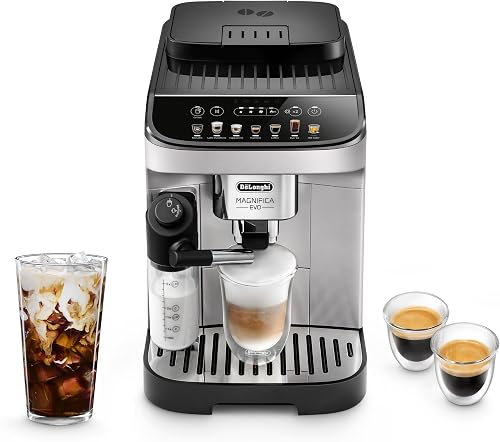
This is a bean-to-cup machine. It grinds and brews with no hands-on work. It offers seven one-touch recipes, a hands-free milk frother with the LatteCrema System, and a 13-setting grinder. The MyLatte function lets you save your own drink.
The built-in grinder is the part to pay attention to. Because the beans are ground right before each shot, you don't need a separate grinder on the counter, and you can adjust the grind across 13 settings to suit your beans and taste.
The one-touch recipes cover the drinks most people order at a cafe: espresso, cappuccino, lattes, and iced coffee. The Over Ice recipe adjusts the dose and brewing on its own, so you don't have to change anything to get a bold, balanced iced drink.
The LatteCrema frother is hands-free, which means you don't need to steam milk by hand or judge when it's ready. It works with dairy or plant-based alternatives. The frother and its parts are removable and dishwasher-safe, so cleaning after a milk drink takes less effort.
Use MyLatte once you have a drink you return to often. It stores your preferred version so you can make it again with a single tap.
Pros
- Fully automatic, so it's the easiest route to a cafe-style drink
- Hands-free milk frother works with dairy or plant-based milk
- Removable, dishwasher-safe parts
Cons
- Less control over the shot than with a manual machine
- Seven recipes is a smaller menu than some other models here
7. De'Longhi Magnifica Duo Automatic Espresso Machine
This model adds drip coffee and cold brew to the automatic mix. The listing describes a wide range of hot and iced presets and several brewing technologies. It has LatteCrema Hot and Cool systems for both warm and cold foam, and a built-in conical burr grinder.
Its brewing technologies unlock a full set of recipes, each with its ideal brewing method. The listing says the technologies are used for authentic espresso, drip coffee and cold brew, so the machine picks the approach that suits the drink you chose. That matters most if you switch between a morning espresso, a drip-style cup and an iced drink in the same day.
The milk side works the same way. The LatteCrema systems handle both dairy and plant-based milks, which the listing says can be frothed into hot or cold foam. If you use oat or almond milk regularly, that's the feature to check first, because not every frother handles those milks well.
Its built-in grinder freshly grinds beans for each drink, so no separate grinder is needed. The listing describes a conical burr grinder built for long-lasting performance.
Who this is less suited to: if you mostly want one plain espresso and never touch iced drinks or cold brew, you're paying for modes you won't use. In that case a simpler model in this lineup covers your needs.
8. De'Longhi Rivelia Automatic Espresso Machine
The Rivelia's presets cover the drinks most people order at a café, including latte, cappuccino, cortado, flat white, iced coffee and espresso over ice. With one touch, the machine grinds, doses, brews and froths, so you don't need to adjust the settings yourself for a standard drink. That makes it a good fit for a household where several people want different coffees and no one wants to learn a manual process.
The two removable 8.8-oz bean hoppers are the feature to think about if you drink both regular and decaf. You fill one with each bean type and swap them in as needed, rather than emptying and cleaning a single hopper every time you change. Keep the hoppers labeled so you always know which one is loaded.
The extra shot function and the drink intensity and quantity settings let you fine-tune a drink once you know how you like it. Start with the preset, then change one setting at a time so you can tell which change made the difference.
The LatteCrema Hot system works with dairy milk and plant-based alternatives. If you use a plant-based milk, check that the result suits your taste, since foam from different milks can vary. The Bean Adapt guidance walks you through setting and saving the grind, dose and temperature for your beans, which is useful when you switch to a new bag and want a consistent cup without trial and error.
Pros
- Two bean hoppers make switching between regular and decaf easy
- Adjustable drink strength and quantity
- Auto-clean function for the milk system
Cons
- Cold foam isn't listed, so iced milk drinks may need extra steps
- Hot foam only
9. De'Longhi Eletta Explore Espresso Machine with Coffee Grinder
The Eletta Explore suits someone who wants a wide range of drinks without learning to pull shots by hand. The built-in burr grinder grinds whole beans fresh for each drink, so you get a consistent dose every time instead of relying on pre-ground coffee. The LatteCrema system works with dairy or plant-based milk and produces either hot foam for cappuccinos or cold foam for iced lattes, without you having to steam milk yourself.
Cold brew is a useful feature to know about. The machine's Cold Extraction Technology controls water flow, pressure and temperature to make cold brew in less than three minutes. That's much faster than the usual overnight steep, so it's worth trying if you drink iced coffee regularly.
The touch display is in full color and uses soft-touch icons, so browsing recipes and adjusting a drink is straightforward. Once you have a favorite setup, you can save it as a profile. Bean Adapt Technology and the Coffee Link app let you customize recipes further and keep them stored. Removable parts are dishwasher-safe, which helps with routine cleanup.
If you mostly want a single espresso or latte and never plan to change settings, a simpler machine will do the job. The extra recipes and app features are most valuable to people who enjoy experimenting.
Pros
- Color touch display is easy to browse
- App connectivity for saved profiles
Cons
- Many features may take time to explore
- App features depend on your phone setup
10. De'Longhi PrimaDonna Aromatic Fully Automatic Espresso Machine
This is the most automated machine in this roundup, and that automation is the main reason to choose it. Bean Adapt and Adaptive Grinding are listed as setting the grind for you by recognizing your beans, which means less time dialing in a shot after every change of coffee. If you buy a new bag often or simply don't want to adjust a grinder, that hands-off approach removes a step that trips up many home brewers.
The 38 presets cover espresso, drip coffee, cold brew, and iced drinks, including iced lattes, cappuccinos, cortados, and flat whites. Rather than choosing a brewing method and then working out the recipe yourself, you select a drink and the machine uses the brewing method suited to it. That makes it easy to move between a morning espresso, an afternoon iced coffee, and a weekend drip cup without changing equipment.
Milk is handled by the LatteCrema Hot and Cool technologies, which turn dairy or plant-based milk into a range of textures you can adjust. You can go from silky steamed milk for a latte to light, airy cold froth for an iced drink. The frothing parts are removable and dishwasher-safe, which makes cleanup simpler than with many machines that require hand washing the milk system.
The trade-off comes with the same automation. Because the machine makes the grind and shot decisions, you get less direct control over the espresso itself. If you enjoy tweaking grind size, dose, and extraction to chase a particular flavor, this design will feel limiting. The large menu also matters only if you'll use it: if you mostly drink one or two drinks, the extra presets add little, and a simpler machine may suit you better.
FAQ
Do I need a grinder?
It depends on your routine. Machines with a built-in grinder give you fresh grounds with each shot. Without one, you'll need to buy pre-ground coffee or add a separate grinder, and freshness will vary.
Which type is easiest for a beginner?
Fully automatic models do the most work for you. A guided model like the La Specialista Touch can help you learn while you brew.
What is the difference between manual and automatic?
Manual machines let you control grind, dose, tamp, and milk texture yourself. Automatic machines handle those steps with a button press, so they're faster but give less direct control.
What is Cold Extraction Technology?
According to the listings, it's De'Longhi's method for making cold brew in a few minutes using set water flow, pressure, and temperature. Several models here mention it.
Can I make iced drinks with these machines?
Many of them can. Several listings mention cold foam, iced coffee, or cold brew presets. Check the drink list on the model you're considering.
Conclusion
Pick the machine that matches how much control you want. If you enjoy the process, a manual or guided model suits you. If you want coffee with one button, an automatic model is the better fit.